As we enter the fourth decade of ERP software, one thing remains disappointingly consistent: the success rate of ERP implementations has not significantly improved. While we’ve learned valuable lessons—like the shift from traditional requirements-driven to solution-driven approaches, and the critical role of Organizational Change Management (OCM)—many ERP programs still fall short of delivering business value.
Although selecting the right ERP software is important, I would argue that choosing the right SI (System Integrator) Partner has an even greater impact on implementation success and long-term value realization. Too often, SI Partner selection is treated as an informal, qualitative manner —when in reality, it’s one of the most consequential decisions in the entire ERP journey.
In this article, I’ll lay out why the current approach to SI Partner evaluations is broken, the risks it creates, and what customers should do differently based on hard-earned experience from over 27 years in ERP delivery.
Learning from the Past – ERP Failures
One of the biggest gaps in today’s ERP selection process is the insufficient attention paid to selecting the right SI Partner. Most of the focus goes to the software—while the team responsible for implementing it gets only a fraction of the scrutiny.
But when ERP implementations fail, it’s rarely because the software was the wrong choice. It’s because of execution breakdowns—and those almost always tie back to the SI Partner.
Consider the results of an informal LinkedIn survey I conducted with ERP implementation leaders.

While not exhaustive, this list provides enough insight to draw several key observations.
- There is an imbalance of risks and rewards between key ERP stakeholders (Vendor, SI Partner, Customer).
- The SI Partner often has a greater influence on ERP implementation outcomes than the ERP Vendor, as reflected in the number and types of challenges commonly linked to their role.
- “Training investment,” “user acceptance,” and “user adoption” are all listed, showing that many customers underestimate the human side of ERP.
Unfortunately, only about 15–20% of a typical ERP selection process is devoted to evaluating SI Partners (source: Third Stage Consulting). Yet, as the observations above make clear, this is where the majority of implementation risk—and opportunity—resides. It’s time for that imbalance to shift. SI Partner evaluation deserves greater focus, aligned with the true drivers of ERP success. In the following sections, we’ll explore where the selection process must evolve—and which criteria actually predict delivery success.
SI Partner Selections – A Critical Review
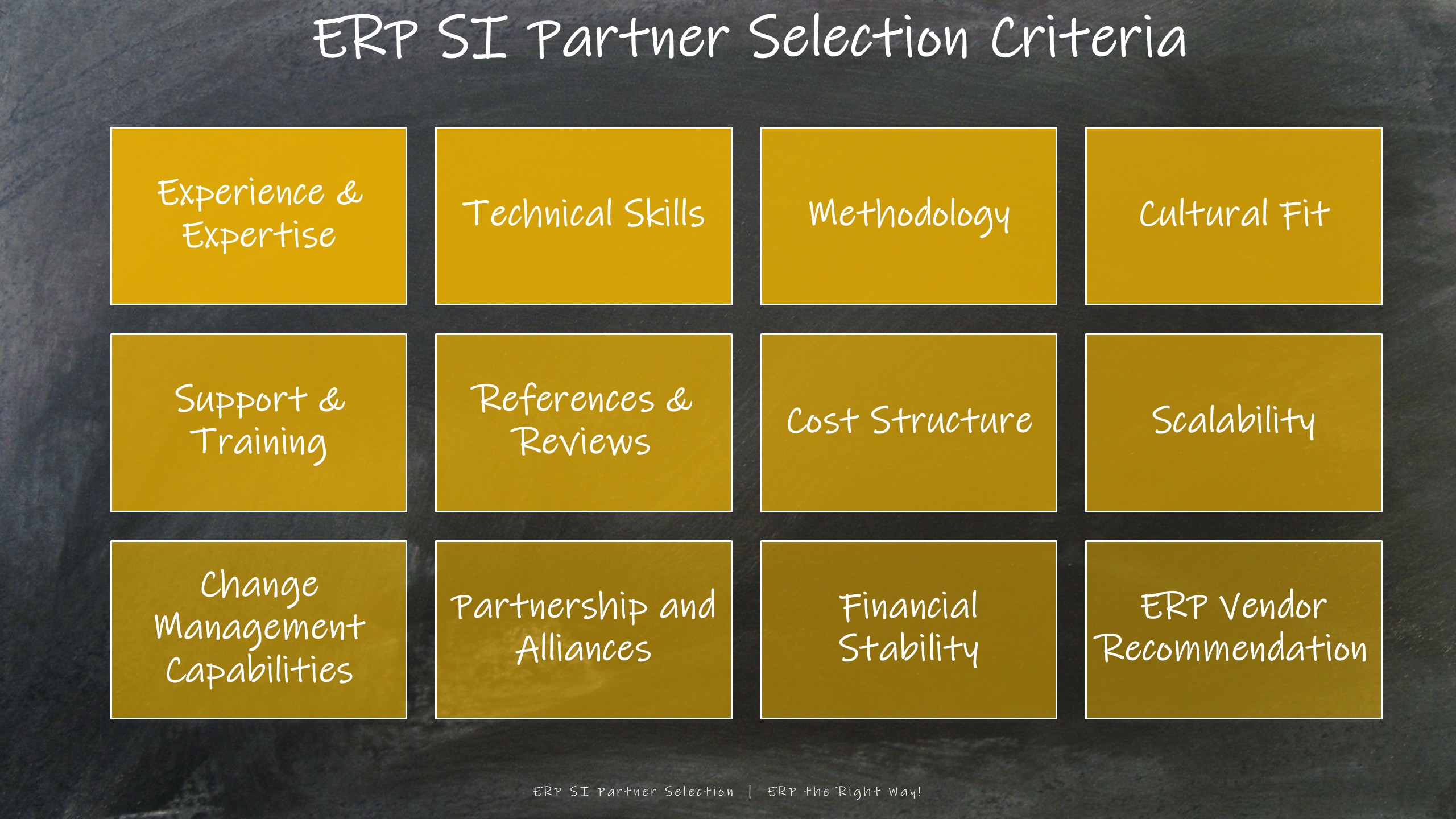
The following represents a standard, high-level set of attributes commonly used to evaluate ERP SI Partners.

Most ERP SI Partner evaluations are still too subjective and focused on interactions with the SI Partner’s sales and leadership team—not the individual consultants who will deliver the work. This creates a dangerous illusion of confidence. Customers end up selecting SI Partners like they are buying commodity services—scoring based on rates, logos, templates, and pitch decks.
I can tell you with absolute certainty: there is no such thing as a standard, repeatable ERP implementation. Every project has its own context, politics, pain points, and priorities. If your goal is a truly transformational ERP outcome, customers don’t want a repeatable service—customers want a team that can adapt, think, and lead. Repeatable services create additional margin for the SI—not business value for the customer.
ERP Vendors Must Own the SI Partner Ecosystem They Promote
ERP Vendors should take an active, responsible role in helping customers build a qualified shortlist of SI partners. The truth is, ERP Vendors know their SI Partner ecosystem far better than the customer. They’ve seen who delivers, who struggles, and where each SI Partner’s real strengths lie. Don’t reinvent the wheel. Use the ERP Vendors inside knowledge to narrow the field, then apply your own criteria to find the best fit.
The following are the attributes that any competent ERP Vendor should be able to evaluate and measure for each SI Partner in their network:
| Attribute | Key Points |
| Financial Stability | Default mid-project. Lose key personnel due to cash flow issues. Be acquired (or shut down) unexpectedly. Prioritize short-term billing over long-term success. |
| Partnership and Alliances | Access to ERP Vendor. Influence with ERP Vendor. Preferred or strategic partner status may unlock early access to ERP Vendor tools, environments, or fixes. |
| Scalability | ERP timelines shift—your SI Partner must be able to flex with you. A weak bench means delays, rework, or “learning on the job.” Sudden growth (additional phases, modules, countries) requires resource elasticity. Without scalability, knowledge transfer and continuity break down when staff turnover happens. |
| Methodology | Reduces customer burden and speeds up the evaluation process. Increase consistency across implementations, reducing variance in service quality. Promotes accountability within the SI Partner network. Encourages ERP Vendors to align product strategy with delivery best practices. |
| Technical Skills | Customers can’t validate technical quality they can’t see or measure. ERP Vendors have real-world visibility into partner delivery history. Avoids “smoke and mirrors” from SI pre-sales teams with polished slide decks. Ensure partners use native tools, follow performance standards, and avoid risky customizations. |
However, don’t blindly take the ERP Vendor’s word when they recommend SI Partners. Ask for evidence. Have ERP Vendors provide quantitative data—delivery success rates, customer satisfaction scores, certification levels, and referenceable clients—that support their SI Partner recommendations. This isn’t just about who they like to work with; it’s a test of where their priorities lie. Are they looking out for customer success, or just pushing a partner that benefits their ERP sales channel?
Tip: To maximize leverage and cost savings, align your ERP software selection with your SI Partner selection. Presales is where you, the customer, have the most influence—use it wisely. This is the moment when both the ERP Vendor and SI partner are motivated to win your business, so bring them to the table together, ask the hard questions early, and negotiate from a position of strength.
All Short-Listed SI Partners should be part of ERP Vendor demonstrations.
The shortlist of SI Partners provided by the ERP Vendor should be involved in the ERP software selection and demo process—not brought in afterward. Involving them early promotes greater transparency, stronger knowledge sharing, and often results in a more cost-effective and accountable selection process.
For example, if the ERP Vendor makes questionable or overly optimistic claims about functionality, a knowledgeable SI Partner can step in to validate—or challenge—those assertions. Their presence acts as a real-time reality check, helping customers make more informed decisions and reducing the risk of surprises later in the project.
Tip: In general, ERP Vendors have separate teams for presales and delivery. The majority of presales consultants come from a “dated” delivery background. Presales consultants are trained and rewarded for getting to “yes”. There is no unethical agenda, however you as the customer need to appreciate each stakeholder and their drivers.
The second area that the customer should validate is technical skills. A partnering ERP Vendor should provide the following analysis for each recommended SI Partner:

I will elaborate on one area that is a constant challenge in a global delivery model. Data conversion is the “long pole” in the tent. Data conversion is a prerequisite for all other functional and technical activities in an implementation project. To be as cost effective as possible, many SI partners will have a dedicated team that only focus on data conversion and that team may be in a different time zone. The constraints that the customer should appreciate are (1) the data conversion team are working on multiple implementations in parallel and (2) the SI partner’s data conversion team may not be 100% available to a specific customer.
Tip: The customer should insist on a minimal window of availability to the customer staff during their normal work schedule (minimum of 4 hours).
Next, the customer should move forward with reviewing the following attributes for each SI Partner:
| Attribute | Guidance |
| Experience and Expertise | Start by asking the ERP Vendor to identify SI partners with a proven track record in your specific industry (cross reference back to their recommendations). Reviewing real case studies and client testimonials can reveal far more than a polished proposal. |
| Customer References | Securing formal customer references requires a SI Partner to stretch and invest beyond the Statement of Work (SOW). Customer references are a great indicator of the partnership that a SI Partner will have with the customer. A credible SI partner should be able to provide formal references for at least 25% of their implementations. |
| Change Management Capabilities | Approach to OCM: Does the SI Partner treat OCM as a strategic workstream or just a communications checklist? Are OCM services delivered by in-house consultants or outsourced? If outsourced, how well are they integrated and held accountable? How does the SI Partner identify change? If you cannot identify organizational change then you cannot manage change. |
| Cultural Fit | You can’t gauge cultural fit from a slide deck. To know if there’s real delivery alignment, interview the actual consultants—not just leadership—and run a working session together. A Phase 0 Readiness Assessment is the best way to move past assumptions and see if they can truly deliver with your team. |
| Cost Structures | Great ERP talent isn’t cheap. If you want top-tier consultants, don’t expect discount rates. Cutting corners now means delays and rework later. A fair margin is ~30%—not 40%+. Big SI Partners have layers of overhead. Smaller firms may deliver more value with leaner teams. You’re paying for every layer, like it or not. |
Buyer Beware – Risk Indicators
Here are some common red flags customers want to keep an eye on when evaluating or working with an SI Partner:
- Bait-and-Switch on Resources: The A-team that shows up for the sales pitch may not be the one doing the actual work. Ask for named resources in the contract.
- Internal Knowledge Gaps: If their own team can’t transfer knowledge well, what does that say about their ability to transfer it to your team?
- Independent Contractors vs Employees: Over-reliance on 1099s can lead to inconsistency, weak accountability, and lack of continuity.
- Polished Deliverables ≠ Good Decisions: Just because something looks nice doesn’t mean it’s aligned with your business goals. Watch the substance.
- Estimate Games and No Buffer: If the estimate feels too good to be true, it probably is. Always ask about contingency and risk assumptions.
- On-the-Job Learning: Every project has a learning curve, but you shouldn’t be paying for them to learn the basics.
- Billing Games: Be on the lookout for questionable billing—understated, overstated, or just vague. Scrutinize time logs and roles.
- Extreme Claims: “We’re 100% Agile!” or “We’re always on time and under budget” are sales red flags. No one’s perfect.
- Missing or Dated References: If they can’t provide recent, relevant clients to speak with, dig deeper. Something may be off.
- Single SI Recommendation from Vendor: One option isn’t a choice—it’s a setup. Push for multiple partner options.
- No OCM Offering: If the SI can’t support change management, guess who owns user readiness and adoption? The customer does.
Customer – Know Thy Self
Before launching your ERP implementation, customers need to take a hard look at their own capacity and capability. Don’t sign up for responsibilities you can’t deliver on. A seasoned SI Partner can advise, but only you the customer can judge whether your organization is truly ready to lead and support the effort.
Make sure you’ve built a realistic contingency budget—because unplanned issues aren’t optional, they’re inevitable. And be honest about the legacy decisions and “sacred cows” you’re bringing into the project. Things like undocumented configurations, untracked customizations, or direct SQL updates in production over the last 3–5 years can double or triple your implementation effort. These are your risks, not the SI Partners’—and they’re rarely visible until it’s too late.
Lastly, align your expectations with what you’re willing to invest. If you want a quality outcome, it takes quality resources—on both sides of the table.
Summary
ERP success hinges more on the SI Partner than the software itself. This article reframes SI selection as a strategic decision—focusing on real-world delivery capabilities, cultural fit, methodology execution, and organizational readiness. It offers practical guidance to help customers move beyond checklists and identify partners who drive results, not just complete tasks. The right SI Partner doesn’t just implement ERP—they help you realize its full value.
This is the first in a four-part series on ERP System Integrator (SI) Partner Selection. Each article will dive deep into the selection process and outline the specific responsibilities each stakeholder—Customer, ERP Vendor, and SI Partner —must own to drive a successful outcome. Selecting the right SI partner isn’t just a decision—it’s a shared responsibility.
References:
- Third Stage Consulting – ERP implementation partner selection biases thirdstage-consulting.comthirdstage-consulting.com
- Third Stage Consulting – Importance of choosing the right implementation partner thirdstage-consulting.comthirdstage-consulting.com
- Forrester Research (2024) – ERP buyers usually pick software before services (partner) – need to involve partners sooner forrester.com
- Info-Tech Research Group – “Implementation partner often an afterthought” (as important as software) infotech.com
- Panorama Consulting 2022 ERP Report – Many firms rely on SIs without independent evaluation (use of outside consultants dropped from 81% to 45%) f.hubspotusercontent40.netf.hubspotusercontent40.net
- Trenegy (ERP consulting firm) – Observation that most selection teams neglect dedicated SI selection, despite its equal importance trenegy.com
- Recap: Big Consulting’s Inflection Point – Usman Sheikh


Leave a Reply